

Automated Contract Generation vs Manual Drafting
Manual drafting vs automated contract generation in real estate deals

Marcus, a Phoenix wholesaler, sat in front of a Google Docs file labeled “PSA_v17_FINAL.” He had three deals under contract and two buyers waiting. The only thing between him and assignment fees was paperwork. He copied clauses from an old deal, swapped names, missed one entity, and sent it anyway.
“This always takes longer than it should,” he said after catching the error an hour later.
That gap, between having a deal and having a clean contract, is where most operators quietly bleed time.
Automated contract generation and manual drafting are not close substitutes anymore. They are two different operating models.
- Manual drafting relies on memory, old files, and repetition
- Automation relies on structured deal inputs and reusable clause systems
The difference shows up fast. Manual workflows slow dispositions. Automation compresses that lag so buyers get clean paperwork while intent is still hot.
According to the 2023 Legal Tech Survey, document drafting still consumes a major share of operational time in legal workflows. Real estate operators feel that same drag, just without calling it “legal ops.”
Why most of your contract time has nothing to do with legal review
Most operators assume contracts are slow because of legal complexity. That is not what actually eats time.
In one tracked deal pipeline, drafting took the majority of the turnaround. Not review. Not negotiation. Drafting. Copying clauses, renaming parties, adjusting edge cases. The same work repeated across every deal.
This lines up with broader workflow data. The McKinsey research on legal automation shows that document creation is one of the most automatable parts of legal work, yet it remains heavily manual in most businesses.
For a wholesaler pushing consistent volume, that means:
- Delays sending contracts to buyers
- Higher chance of clause mismatch or outdated language
- More back-and-forth to fix preventable errors
And that last point matters more than most realize. A sloppy contract slows buyer confidence. Buyers stall when documents feel inconsistent. That hesitation costs deals.
The issue is not legal knowledge. It is process design.
The contrarian take: better templates do not fix drafting speed
The common advice is to “build better templates.” That sounds right but breaks at scale.
Templates still assume a human sits down, opens a document, and assembles it manually. Even if the starting point is cleaner, the workflow remains fragile.
Operators using Google Docs, DocuSign, or PandaDoc templates still run into the same friction:
- Searching for the right version
- Editing fields one by one
- Handling edge cases manually
Tools like PandaDoc and DocuSign improve formatting and signatures, but they do not solve the upstream issue of assembling the contract correctly every time.
The shift happens when contracts stop being documents and start being outputs of a system. That system starts with structured inputs, not blank pages.
That is where automated contract generation separates itself. It removes the drafting step entirely instead of trying to optimize it.
How automated contract generation actually works in a deal pipeline
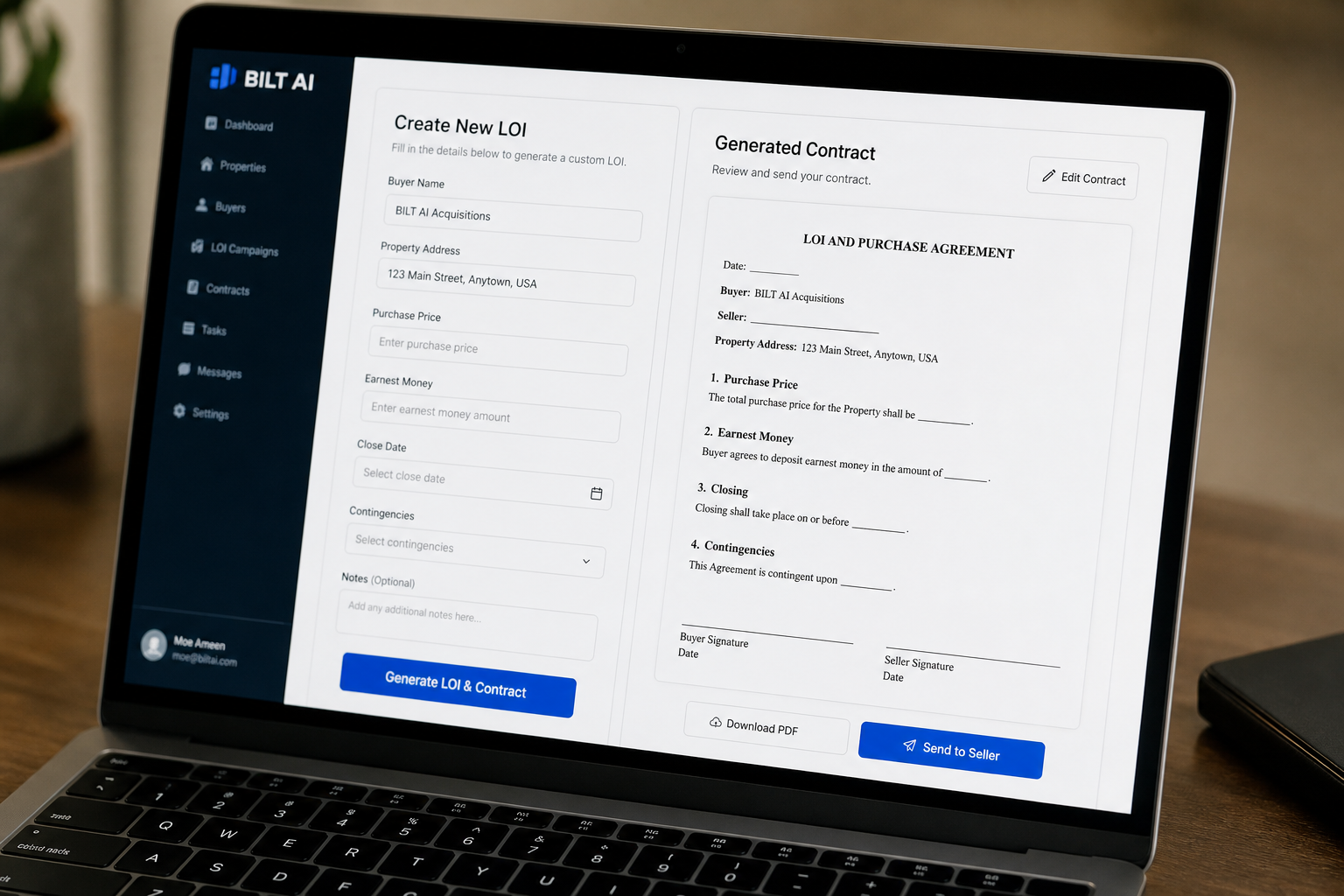
At an operator level, automated contract generation is simple when broken into components.
First comes deal data. This includes seller name, buyer entity, purchase price, EMD terms, closing timeline, and any special conditions tied to the deal.
Next is a clause library. These are prebuilt legal blocks that reflect how you actually structure deals. Assignment clauses, inspection periods, default language, and addenda all live here.
Then comes assembly. The system maps inputs into the correct clauses and produces a complete draft without manual editing.
This is the exact model used inside Kompozy. An intake form feeds structured data into a Persona Brief, which maps variables into clause blocks, then outputs a finished contract across channels.
If you are running any meaningful deal volume, this replaces hours of repetitive work each week.
For operators already using outbound systems to source deals, this becomes the natural next step. If you are already pushing LOIs at scale through BILT AI CRM, your bottleneck shifts to contract execution. Automating that stage keeps the pipeline moving without adding headcount.
The 5 clause system that removes 80% of drafting work
This is the part worth saving. Most real estate operators only need a handful of clauses to eliminate the bulk of manual drafting.
The 5-Clause Automation Framework
- Buyer and Seller Identity Block
Variables: entity name, signing authority, contact details
Tool: intake form or CRM field mapping - Purchase and Assignment Terms
Variables: price, assignment fee, earnest money structure
Source: your last 10 executed deals - Inspection and Contingency Window
Variables: days for due diligence, access terms
Consistency matters more than customization here - Default and Remedies Clause
Variables: rarely change, standardize once and reuse - Closing Timeline and Title Company
Variables: closing date, title provider, jurisdiction language
Each clause becomes a modular block. Instead of editing text, you swap variables.
Once these five are structured, most contracts assemble automatically. Edge cases still exist, but they become exceptions rather than the default workflow.
Operators who implement this see an immediate shift. Drafting becomes a background process instead of a task on the to-do list.
Where automation breaks if your inputs are messy
Automation only works if your inputs are clean. That is where most systems fail.
Incomplete deal data creates broken contracts. Inconsistent naming leads to mismatched entities. Missing fields force manual intervention, which defeats the purpose.
This is why tools like Google Forms or structured CRM pipelines outperform freeform workflows. They force consistency at the input level.
A Dallas-based acquisitions manager described it best after switching systems: “We stopped asking people to write details and started forcing them to select from options.” That single shift reduced contract errors immediately.
Structured inputs do not feel flexible, but they create reliability. And reliability is what allows automation to hold up under real deal volume.
If contracts are still being edited after generation, the issue is almost always upstream.
What this changes for real estate operators running volume
When automated contract generation is in place, the downstream effects show up quickly.
Buyers receive contracts faster. That alone increases close rates because momentum stays intact.
Teams stop duplicating effort. Acquisitions, dispositions, and operations work from the same structured data instead of passing documents back and forth.
And most importantly, operators reclaim time. Not in theory, but in daily workflow. Hours that used to be spent drafting are now available for sourcing deals, negotiating, or building buyer relationships.
The operators scaling right now are not doing more work. They are removing the parts of the workflow that should never have been manual in the first place.
Next 48 hours: implement automated contract generation
1. Audit your last 10 contracts. Identify the clauses that repeat with minimal changes. Pull them into a single document.
2. Create a structured intake form using a tool like Google Forms or your CRM. Include required fields for buyer, seller, price, EMD, and closing terms.
3. Convert your top clauses into variable-driven blocks. Replace names, dates, and numbers with placeholders tied to your intake fields.
4. Test assembly on a live deal. Generate a full contract without manual editing. Track where it breaks.
5. Fix inputs, not outputs. Adjust your form or data capture process instead of editing the contract itself.
If you want to see how this runs inside a real pipeline, book a walkthrough of BILT AI. It is the same system operators use to move from outbound deal flow to executed contracts without bottlenecks.
And if you are building your own content and workflow systems around this, Kompozy is where we run the backend logic. More on that at Kompozy.
Frequently Asked Questions
What is automated contract generation in real estate?
Automated contract generation creates real estate contracts using structured deal data and prebuilt clause libraries instead of manual drafting. Tools like PandaDoc and custom systems assemble documents instantly once inputs are complete.
How much time can automation save on contracts?
Automation removes most drafting time, which is often the largest portion of contract turnaround. In tracked pipelines, operators found drafting consumed the majority of effort before switching to structured assembly.
Do I still need a lawyer if I automate contracts?
Yes, legal review still matters for clause accuracy and compliance. Automation handles drafting, while attorneys validate the structure and language when needed.
What tools help with contract automation?
Tools like DocuSign and PandaDoc handle document workflows, while systems like BILT AI CRM and Kompozy manage structured data and automated assembly inside real estate pipelines.
Why do automated contracts fail sometimes?
Failures usually come from bad inputs, not the automation itself. Missing fields or inconsistent data lead to incorrect outputs, which is why structured intake forms are required.


© Copyright 2024 by BILT. All rights reserved.


