

Change Your Real Estate Trajectory With One Input
A Houston wholesaler, 47 unread emails, and one broken input

Jared runs dispositions in Houston. His inbox showed dozens of unread replies from property owners, but none were usable. The subject lines looked right, the lists were fresh, and yet every thread died after the first response.
One reply summed it up: "Is this spam or are you actually buying?" That line showed the real problem. The issue was not volume. It was one input he had been repeating.
He was blasting offers from a domain that had no history, no reputation, and no trust signal. Google treated him like a stranger asking for a wire transfer.
That single input shaped everything downstream. Response quality, deal flow, even how sellers perceived his credibility. Nothing else mattered until that got fixed.
This is where most operators stall. They stack tactics when one variable is dragging the entire system down.
The input loop that actually drives deal flow
Every real estate pipeline is a loop of inputs and outputs. Lists go in. Messages go out. Conversations turn into contracts. Contracts turn into assignment fees or closings.
Break one part of that loop and the entire machine feels random.
Data backs this up. The 2024 Federal Reserve Small Business Credit Survey showed that consistency in operational processes directly impacts revenue predictability. Real estate is no different. Predictable inputs create predictable deal flow.
In outbound specifically, sender reputation is one of the most sensitive inputs. Google documented this in their Postmaster Tools guidelines. New or inconsistent sending behavior reduces inbox placement fast.
Jared did not need a new list. He needed to fix the way his emails entered the system.
Once he warmed the domain, slowed the daily send, and aligned copy with actual buying intent, replies changed tone. Sellers started asking timelines instead of questioning legitimacy.
That shift came from one corrected input, not a complete overhaul.
Why changing everything at once kills most investors

There is a pattern that shows up across wholesalers, agents, and buy and hold investors. When results stall, they attempt to rebuild the entire operation in one sprint.
New CRM. New list source. New skip tracing provider. New outreach channel.
It feels productive. It usually resets progress to zero.
The IRS has long documented how inconsistent business processes increase failure rates among small operators, especially when record keeping and systems are constantly changed mid cycle. Their small business guidance highlights consistency as a core factor in sustainable operations. You can see that reflected in their official documentation at IRS Small Business Resources.
In real estate terms, this shows up as half built pipelines. A list gets pulled but not fully worked. Conversations start but never get follow up. Offers are sent without structured tracking.
One operator in Phoenix shifted this by simplifying. Instead of rebuilding everything, she focused only on follow up cadence. Within a single operating cycle, her existing conversations started converting because they were finally being worked properly.
Most pipelines are not broken. They are inconsistent.
The contrarian move: ignore scale, fix the constraint
The common advice says scale outreach when deals slow down. More calls. More emails. More offers.
That advice breaks when your constraint is quality, not volume.
Scaling a broken input just amplifies the problem.
Jared could have doubled his send volume. That would have produced more low quality replies and more spam flags. Instead, he reduced volume temporarily and fixed deliverability.
That decision goes against what most outbound playbooks recommend. It also aligns with how email systems actually work. Platforms like Gmail prioritize sender behavior patterns over raw volume.
Once the constraint was removed, volume became useful again.
This is where tools matter. If you are running consistent outbound across multiple lists and markets, manual tracking breaks fast. That is exactly why BILT AI CRM exists. It handles LOI blasting with infrastructure that respects deliverability, so you are not guessing which input is failing.
The sequence matters. Fix constraint first. Then scale.
A daily execution system that compounds in real estate
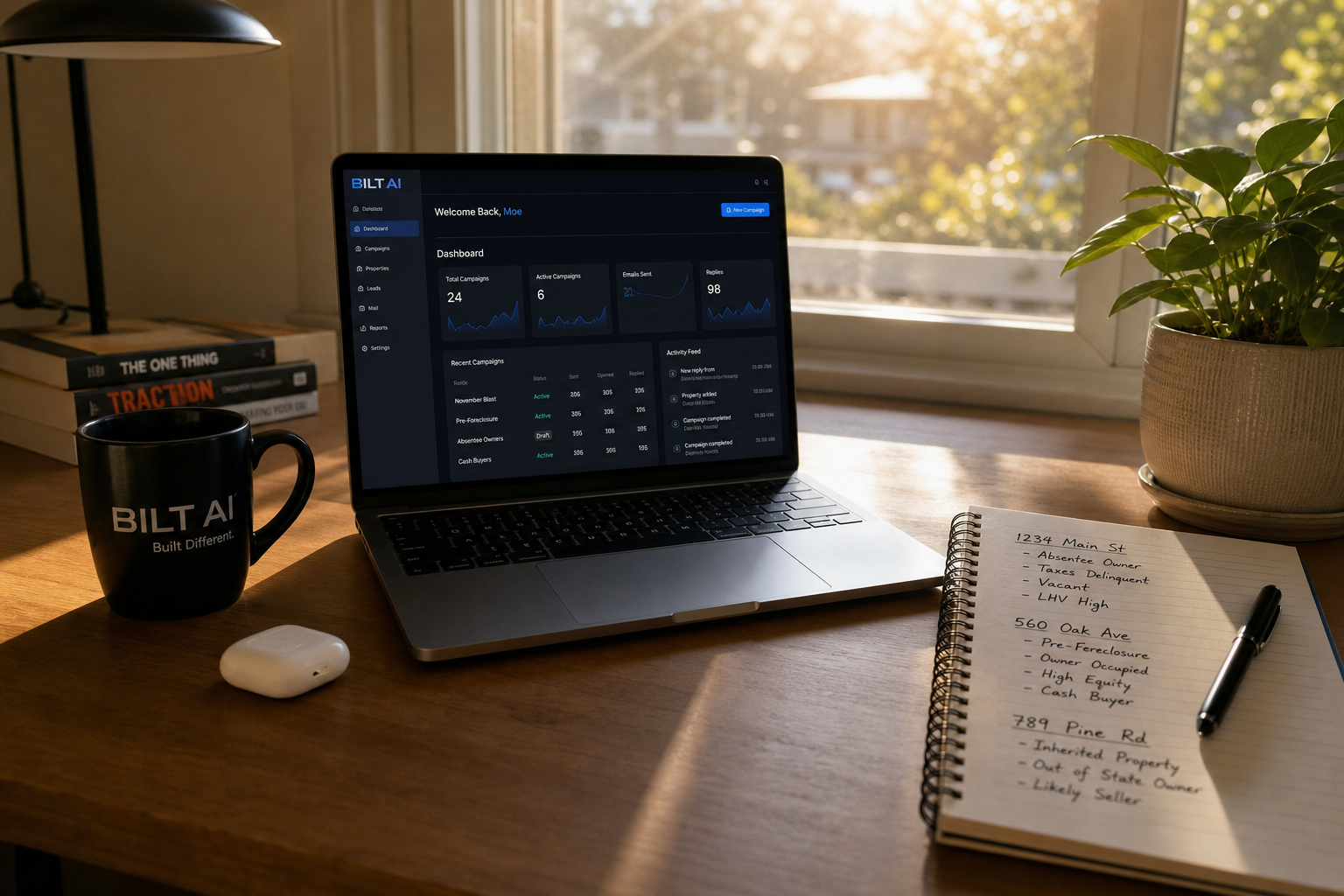
The fastest trajectory shifts do not come from massive changes. They come from repeated execution on one controlled input.
That can be one of several levers depending on your business model.
For wholesalers, it is often outbound consistency. For agents, it is follow up discipline. For buy and hold investors, it might be underwriting accuracy.
What matters is that it happens daily.
One operator in Dallas built a routine around outbound emails. Every day, the same process ran. Lists were verified. Campaigns were sent within a controlled range. Replies were handled the same day.
Within one operating cycle, inbound conversations started to feel predictable. Not because the market changed, but because the input stayed consistent.
That consistency compounds faster than any single tactic.
There is also a lifestyle component that operators underestimate. Sleep schedule, distractions, and environment all feed into execution quality. These are not soft variables. They directly affect how well your pipeline runs.
Clarity shows up in underwriting decisions, negotiation tone, and how quickly you respond to sellers.
The operator artifact: single input execution checklist
This is the framework used internally when diagnosing a stalled pipeline. It is designed to isolate and fix one input before anything else changes.
Single Input Correction Checklist
- Identify the constraint: Look at where deals are dropping. No replies, weak conversations, or failed closings.
- Trace upstream: Map that failure back to the exact input causing it. Example: poor inbox placement instead of bad list quality.
- Validate with a tool: Use platforms like Google Postmaster Tools or your CRM analytics to confirm behavior.
- Reduce volume temporarily: Lower activity to isolate signal from noise.
- Correct the input: Adjust domain setup, messaging, follow up cadence, or underwriting criteria.
- Run for a full cycle: Do not change anything else until one full pipeline cycle completes.
- Measure output shift: Track reply quality, conversion rate, or signed contracts.
- Only then stack the next input: Move to the next constraint after stability returns.
This checklist prevents the constant reset loop that most investors fall into.
It also forces discipline. You cannot fix five things at once if you are measuring correctly.
Environment and relationships still shape your pipeline

Location and network still matter more than most spreadsheets reflect.
Investors in active markets tend to operate at a higher baseline simply because of exposure. Conversations are sharper. Expectations are clearer. Deal structures evolve faster.
Changing markets is not always practical, but changing proximity is. Events, masterminds, and even digital communities influence standards quickly.
The same applies to personal relationships. A distracted operator produces inconsistent output. A focused operator compounds.
This is not theory. It shows up in response time, negotiation quality, and how often follow ups actually happen.
When your environment supports execution, inputs become easier to maintain. When it works against you, even simple systems break down.
That is why trajectory changes often look like lifestyle changes from the outside. Underneath, they are operational improvements.
What to do in the next 48 hours to change your real estate trajectory
1. Audit your last 20 conversations in your CRM. Identify exactly where deals stopped. Use your existing system or a tool like BILT AI CRM to track this clearly.
2. Pick one input tied to that failure point. Do not pick two. If replies are weak, focus on deliverability or messaging, not both.
3. Run a controlled cycle. Adjust that one variable and execute daily without deviation until you see stable output.
4. Document the before and after inside your pipeline. Track how conversations change, not just how many you have.
5. Once stable, stack the next improvement. Repeat the same process.
If your outbound system is the bottleneck and you want it set up correctly without trial and error, you can book a walkthrough with BILT AI CRM and see how operators are running consistent LOI campaigns without burning domains.
If you are building your content and outbound together, Kompozy is where we structure that workflow so it actually compounds.
Frequently Asked Questions
How do I know which input is hurting my real estate pipeline?
Look at where deals stop, then trace backward to the step that caused it. If sellers reply but do not engage, the issue is messaging or trust. If they never reply, tools like Google Postmaster will often show deliverability issues.
Should I increase outreach volume when deals slow down?
No, not until the constraint is fixed. Increasing volume with poor deliverability or weak messaging usually lowers performance further, as seen in Gmail sender guidelines where inconsistent patterns reduce inbox placement.
What is the most common broken input for wholesalers?
Deliverability and follow up cadence are the most common. Many operators send from untrusted domains or fail to maintain consistent follow up, which kills otherwise viable conversations.
How long should I focus on one input before changing another?
Run it for a full pipeline cycle. That means from initial outreach to either signed contract or dead lead, so you can measure real output changes instead of partial signals.
Do tools like BILT AI CRM actually improve results?
Yes, because they control inputs like sending behavior and tracking. When outbound is structured correctly, reply quality improves, which directly impacts deal flow.


© Copyright 2024 by BILT. All rights reserved.


