
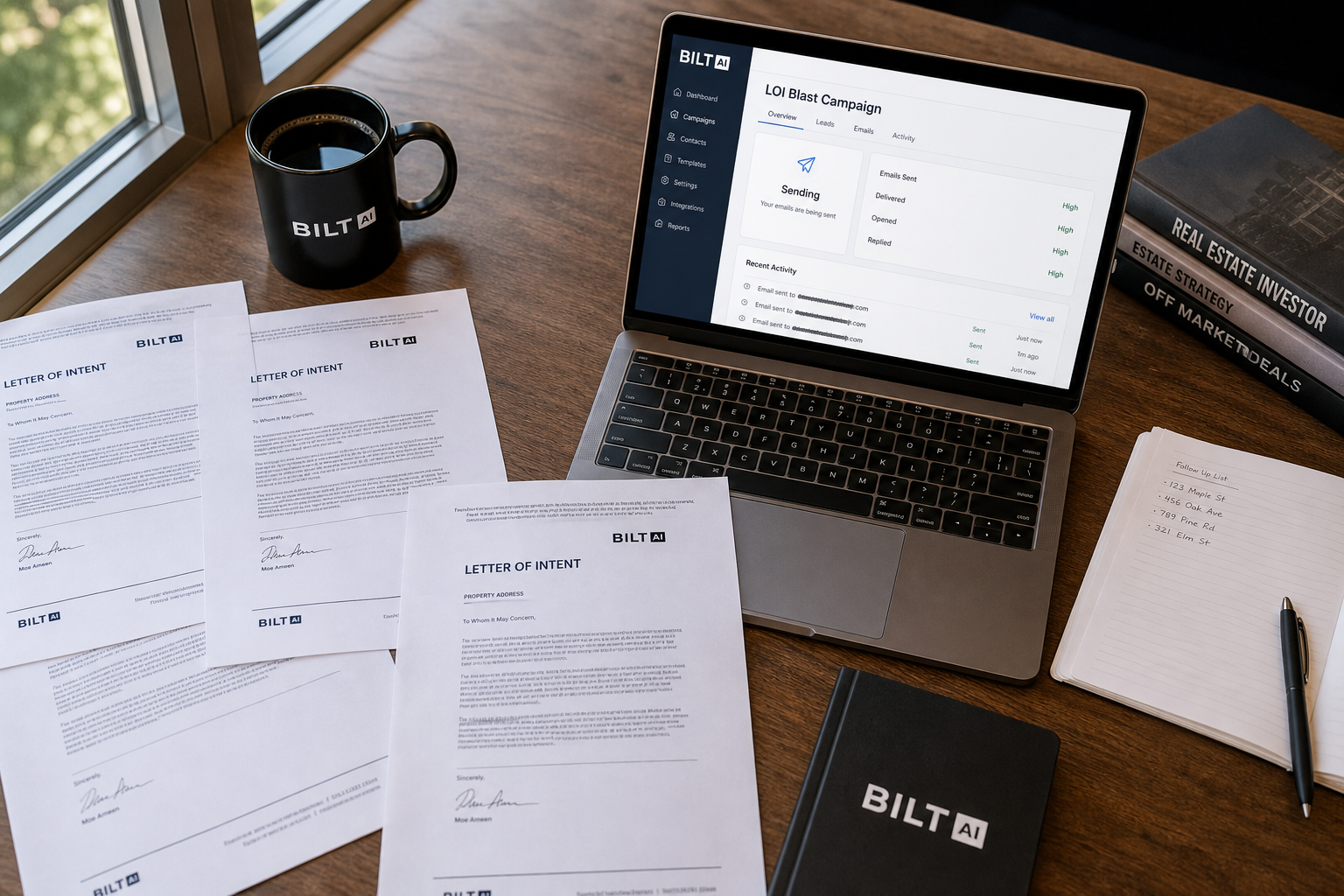
LOI Blasting for Wholesalers: Volume Wins
“Personalize every LOI and send fewer, higher quality offers.” That advice is costing wholesalers deals.
“Personalize every LOI and send fewer, higher quality offers.”
That line sounds responsible. It also slows most operators down enough to miss the actual opportunity sitting in their list.
Inside BILT AI CRM logs, one pattern shows up repeatedly. Campaigns pushing high volume with controlled structure consistently outperform low volume “perfect” campaigns. The difference is not subtle. One approach compounds. The other stalls out waiting for replies that never come.
LOI blasting for wholesalers is not about writing better emails. It is about building a system that produces consistent outbound at a scale that forces responses. When that system is structured correctly, the market tells you what works fast enough to adjust in real time.
The operators who figure this out stop treating outreach like a creative exercise. They start treating it like inventory movement.
Why 1,000 LOIs in a day beats 100 “perfect” ones
The biggest misconception in LOI blasting for wholesalers is that conversion happens at the message level. In reality, conversion happens at the system level.
Sending 100 carefully written LOIs over a week feels productive. It is not. You are collecting feedback too slowly to iterate, and your sample size is too small to trust any signal.
Sending 1,000 LOIs in a single day changes the game. Patterns show up immediately. Subject lines either pull opens or they do not. Offer framing either gets replies or it does not. There is no guessing because the data forces clarity.
Google and Yahoo tightened bulk sender requirements in 2024, which made randomness in sending behavior more risky. Structured volume actually aligns better with these systems when it is consistent and predictable. You can review their guidance directly here: Google bulk sender guidelines and Yahoo sender best practices.
Operators who throttle volume out of fear usually end up with worse deliverability because their patterns look inconsistent. Volume itself is not the problem. Unstructured volume is.
The shift is simple. Stop asking how to make one LOI better. Start asking how to make 1,000 sends behave predictably.
The system that actually moves deals: rotation, not perfection

What worked inside our own outbound was not a breakthrough in copy. It was a repeatable rotation system.
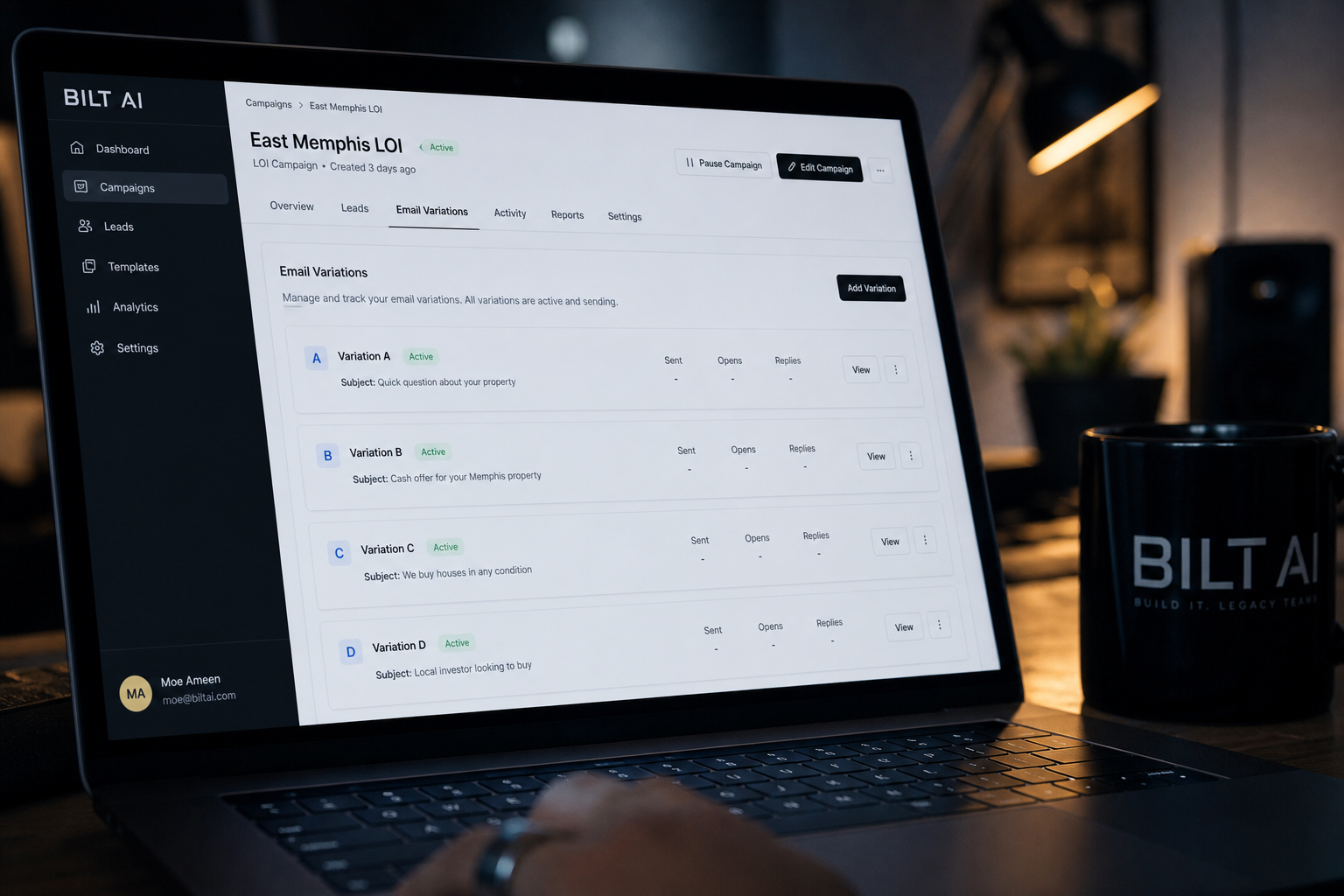
Three subject line variants rotate every set of sends. Two body frameworks alternate based on intent. Lists refresh daily using simple filters like equity and ownership duration. That combination creates controlled variation without introducing randomness.
Here is the key. You are not trying to win with one email. You are running multiple controlled tests at once, every day, without rebuilding from scratch.
This is where most wholesalers fall off. They treat each LOI campaign like a one-time event. New list, new copy, new everything. That resets learning back to zero every time.
Inside Kompozy, we structured this differently. Each LOI angle becomes a reusable frame. Cash offer. Problem-solve. Off-market intro. The system spins variations automatically while keeping the underlying structure intact.
If you are doing this manually in spreadsheets or basic tools like Mailchimp, you will feel the friction quickly. At a certain volume, you need a system that handles rotation without breaking deliverability patterns.
If you are already pushing volume and running into that ceiling, this is exactly why we built BILT AI CRM. It handles LOI blasting with structured rotation instead of one-off campaigns.
Save-worthy artifact: the LOI rotation framework wholesalers actually use
This is the framework that holds the system together. Screenshot it, build it, and run it daily.
LOI Rotation Framework
- Daily send target: Fixed cadence (example: 300 per day minimum, scale upward as domains warm)
- Subject lines: 3 variants rotating every batch of sends
- Body frameworks: 2 types (direct offer vs curiosity-driven opener)
- List refresh: New records daily using equity and ownership filters
- Domain behavior: Consistent daily sending, no spikes or توقف patterns
- Reply tracking: Tag responses by angle, not just campaign
- Iteration cycle: Adjust weekly based on reply patterns, not open rates alone
The reason this works is control. You are not guessing what changed. You know exactly which variable shifted because everything else stayed consistent.
Operators who skip this and chase “better copy” usually end up rewriting the entire campaign every few days. That destroys continuity and makes optimization impossible.
Run this for a week and you will have more usable signal than most wholesalers get in a month.
What most wholesalers miss about LOI blasting systems

The failure point is not effort. It is framing.
Most wholesalers approach LOI blasting like a marketing campaign. Something you launch, monitor, and replace. That mindset keeps everything temporary.
The operators who win treat LOIs like a production system. Lists come in daily. Frames stay consistent. Variations rotate automatically. Replies feed back into the next cycle.
That difference shows up fast. One operator inside our ecosystem shifted from sporadic campaigns to a fixed daily cadence and stopped rewriting emails entirely. The quote that stuck was simple: “We stopped guessing and just started running the machine.”
No new copy breakthrough. No radical strategy change. Just consistency applied at scale.
Kompozy plays a role here on the content side. Instead of writing new angles every time, it builds a topic pool tied to persona frames. Each LOI type becomes reusable input. The system handles variation so the operator focuses on deal flow.
That is the actual unlock. Not creativity. Not cleverness. Output with structure.
Consistency compounds faster than cleverness in real estate outreach
There is a reason this approach feels uncomfortable at first. It removes the illusion of control that comes from rewriting copy.
When you commit to structured volume, you are letting the market respond at scale. That feedback can be blunt. Subject lines fail quickly. Angles get ignored. But the upside is speed. You adjust within days instead of weeks.
LOI blasting for wholesalers rewards operators who can stay consistent long enough to see patterns. Not the ones chasing perfect messaging.
And this compounds beyond email. Once you know which angles get responses, those insights carry into SMS, calls, and even disposition conversations.
The system becomes the asset. Not the individual campaign.
What to do in the next 48 hours
- Build three LOI frames using your current deals as reference. One direct offer, one problem-solve angle, one off-market intro.
- Set a fixed daily send cadence inside your sending tool. Do not change volume daily. Pick a number and hold it.
- Split your list into rotating batches so subject lines and body frameworks cycle consistently.
- Track replies by angle in your CRM, not just campaign level metrics.
- Review after one week and adjust only one variable at a time.
If you are already trying to run this manually and it is breaking under volume, it usually means you outgrew your current setup. That is exactly where most operators reach out to walk through a structured LOI system. You can book a quick walkthrough here and see how we set this up inside BILT AI CRM.
If your focus is building the content engine behind these campaigns, Kompozy is where that layer lives. More on that at Kompozy.
Frequently Asked Questions
What is LOI blasting in real estate wholesaling?
LOI blasting is sending a high volume of letters of intent to property owners through email or direct outreach systems. In practice, wholesalers using structured rotation send hundreds of LOIs daily with controlled variations instead of one-off campaigns.
How many LOIs should a wholesaler send per day?
Most operators see stronger results when they commit to a fixed daily cadence rather than sporadic campaigns. The key is consistency with structured variation, not chasing a specific number each day.
Does personalization matter in LOI emails?
Personalization helps, but volume with structure drives more outcomes. Campaigns with rotating subject lines and body frameworks typically outperform heavily personalized low-volume outreach because they generate faster feedback loops.
How do I avoid spam issues when blasting LOIs?
Follow bulk sender guidelines from providers like Google and Yahoo and keep sending behavior consistent. Structured daily volume with stable patterns performs better than irregular spikes that trigger filters.
What tools are best for LOI blasting?
Tools that support rotation, list management, and reply tracking are essential. Many wholesalers start with basic email platforms but move to systems like BILT AI CRM once volume increases and manual workflows break down.


© Copyright 2024 by BILT. All rights reserved.


