

SMS Outreach Compliance for Real Estate Investors
A list dies faster from non-compliance than bad deals
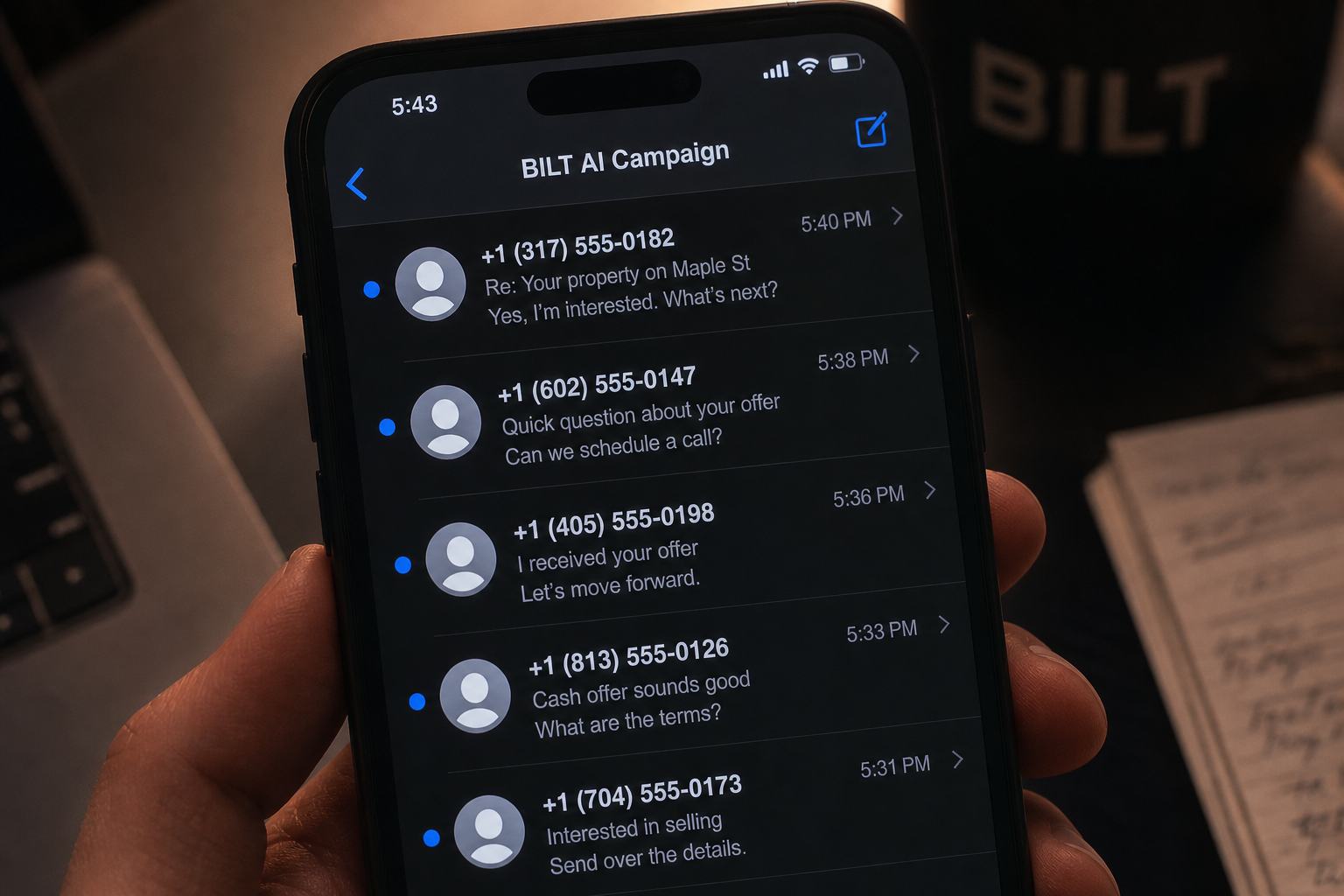
Eric, a wholesaler running deals through REsimpli, pushed a fresh SMS campaign to a few hundred seller leads and watched replies roll in. Then the replies stopped. Carrier filtering kicked in. A few days later, messages weren’t landing at all. The only note he had from a contact was, “I never signed up for this.”
That sequence shows up more often than bad comps or blown ARV assumptions. SMS outreach compliance is what determines whether your list compounds or disappears.
Operators tend to treat compliance like legal overhead. In practice, it acts more like infrastructure. If your consent data is weak, your cadence is aggressive, or your templates drift, carriers and aggregators treat your traffic as spam. Once that reputation drops, even legitimate seller conversations struggle to land.
According to the FCC’s TCPA guidance, express written consent is required for marketing texts. Carriers have tightened enforcement alongside platform rules, especially after the A2P 10DLC rollout that formalized business texting registration.
Lists do not fail all at once. They decay quietly. Open rates dip. Replies slow. Deliverability slides. By the time most investors notice, the channel is already compromised.
SMS outreach compliance means proving consent, not assuming it
Most investors store contacts with a tag like “seller lead” or “SMS subscriber.” That is not compliance. That is a label without proof.
TCPA enforcement hinges on provenance. You need to show how the lead opted in, what they saw when they opted in, and when it happened. Without that, you cannot defend a complaint, and platforms will not defend you either.
The Federal Trade Commission highlights recordkeeping as part of compliant marketing practices in its business guidance on consumer communications, available at FTC Business Guidance. The expectation is not vague. You need a clear audit trail.
For real estate investors, this connects directly to how leads enter your pipeline. Website forms, Facebook lead ads, inbound calls, and JV lists all require different consent handling. A Carrot site form with a checkbox is different from a scraped list uploaded into a CRM.
If you cannot answer these three questions for any contact, your SMS outreach compliance is already broken:
- Where did this lead opt in?
- What exact language did they agree to?
- When did that consent occur?
Anything less turns your outbound into a liability. That liability shows up first as filtering, then as account restrictions, and eventually as legal exposure.
The operator artifact: TCPA-safe SMS compliance snippet
This is the piece most teams miss. You do not need more creativity in your texts. You need consistency in your compliance layer.
Lock this snippet into your system and never hand-edit it again. Whether you are using Twilio, GoHighLevel, or a custom stack, this block stays fixed.
TCPA-safe SMS compliance snippet
- Consent capture: Store timestamp, source URL, and exact opt-in language per contact
- Opt-in language: “By submitting, you agree to receive text messages about your property. Msg & data rates may apply. Reply STOP to opt out.”
- Cadence guardrail: No more than two to three messages per week per contact
- Quiet hours: Restrict sends to standard daytime hours based on contact timezone
- STOP handling: Immediate suppression on STOP reply, no exceptions
- Inactivity rule: Auto-suppress after a defined period of no engagement
- Template consistency: Disclosure language never changes across campaigns
Operators running volume across multiple acquisition channels cannot manage this manually. This is where systems like Kompozy come into play. Inside Kompozy, teams set a Brand Prompt Lane that enforces this snippet across every outbound variation, so even when copy changes, compliance does not drift.
That single constraint removes most of the failure points that cause deliverability issues later.
Cadence is where most investor SMS campaigns get flagged

Sending frequency looks harmless until it compounds. A list that hears from you too often stops engaging, and disengagement is one of the strongest signals carriers use when filtering messages.
Investors tend to push cadence when deals slow down. More texts go out. Follow-ups get tighter. The intention is logical. The outcome is the opposite of what you want.
A wholesaler in Dallas described it bluntly: “We doubled our follow-ups and watched replies drop.” The issue was not the offer. It was the pressure applied to the same contacts without resets or suppression rules.
Carriers do not evaluate your intent. They evaluate behavior patterns. Repeated outbound with low response rates looks identical to spam, regardless of whether your list came from legitimate sources.
Platforms like Twilio publish messaging best practices that emphasize opt-out handling and engagement signals, available at Twilio SMS Best Practices. Engagement is part of compliance in practice, even if it is not written as a law.
Two to three touches per week is not a random rule. It aligns with how quickly engagement drops off without fresh intent from the lead. Once a contact stops replying, continued messaging increases your risk profile without improving conversion.
Cadence is not about how much you can send. It is about how long you can keep sending without getting filtered.
Template hygiene outperforms clever copy in compliant SMS
Most investors spend time rewriting their opening line. Very few standardize their disclosure layer. That imbalance creates risk.
Carriers and aggregators evaluate consistency. If your compliance language changes across campaigns, it signals unpredictability. That unpredictability increases filtering risk.
Keeping disclosures fixed while rotating the value proposition gives you variation where it matters and stability where it is required.
This also reduces operational errors. Teams do not have to remember what to include in each campaign. The system enforces it.
In practice, this looks like separating your SMS into two layers:
- The fixed compliance layer that never changes
- The variable message that tests different angles on the same offer
When teams blur these layers, mistakes happen. A missing opt-out line. A slightly altered disclosure. A template copied from an older campaign that no longer meets current standards.
That is how compliant systems degrade over time. Not from one major error, but from small inconsistencies that accumulate.
Kompozy’s approach of locking compliance into a Brand Prompt Lane addresses this directly. The system generates variations, but the compliance layer remains untouched.
The contrarian view: strict compliance increases deal flow
There is a common belief that compliance limits outreach volume and reduces opportunities. In reality, strict SMS outreach compliance tends to increase conversions over time.
Here is why. Clean lists maintain deliverability. Deliverability preserves conversations. Conversations produce deals.
When a list is compliant, messages land consistently. Sellers respond. Follow-ups reach the same inbox instead of being filtered. That continuity matters more than squeezing extra messages into a short window.
Investors who ignore compliance often see short bursts of activity followed by long periods where nothing lands. The channel becomes unreliable. At that point, even strong offers struggle to perform.
The U.S. Small Business Administration has noted in its marketing guidance that customer trust and permission-based communication directly affect engagement rates, referenced in its business resources at SBA Marketing Guidance. Trust is not abstract here. It shows up as replies and continued conversations.
Compliance builds that trust at a system level. Sellers who opted in are more likely to engage. Carriers recognize the engagement. Your messaging stays deliverable.
The result is not fewer deals. It is a more stable pipeline.
What to fix in the next 48 hours before your next SMS push
If your current SMS setup cannot pass a basic compliance check, fix that before sending another campaign. This is not something to patch after the fact.
- Audit your contacts. Open your CRM and verify that each SMS contact has a recorded opt-in source, timestamp, and consent language. If that data is missing, remove those contacts from SMS campaigns.
- Implement suppression rules. Use your messaging platform, whether Twilio or GoHighLevel, to automatically block contacts after a STOP reply or extended inactivity.
- Lock your compliance snippet. Create a fixed disclosure block and embed it into every template. If you are managing multiple campaigns, move this into a system like Kompozy so it cannot be edited manually.
- Throttle your cadence. Adjust your campaign settings to stay within two to three messages per week per contact. More than that increases filtering risk without improving results.
If you are already running multi-channel outbound and struggling to keep this consistent, that is where systems start to matter more than tactics. The operators scaling clean pipelines are not managing compliance manually. They are enforcing it through infrastructure.
If you want to see how that looks in practice, you can book a short walkthrough of how BILT AI handles compliant outreach from first touch through follow-up.
For teams building content and outbound systems alongside SMS, Kompozy is where the compliance layer gets locked so campaigns can scale without drifting.
Frequently Asked Questions
What is SMS outreach compliance for real estate investors?
SMS outreach compliance means following TCPA rules by collecting and storing clear opt-in consent before sending marketing texts. The FCC requires express written consent, and investors must be able to show when and how that consent was given.
Do I need written consent to text motivated sellers?
Yes, written consent is required for marketing texts. FCC TCPA guidance states that recipients must explicitly agree to receive messages, and that agreement must be documented with the language they saw at opt-in.
How many SMS messages can I send per week to leads?
Two to three messages per week per contact is a widely accepted safe range. Higher frequency often leads to lower engagement, and platforms like Twilio flag low engagement as a spam signal.
What happens if someone replies STOP to my message?
You must immediately stop messaging that contact. SMS platforms enforce automatic opt-out handling, and continuing to message after a STOP reply violates compliance rules and can trigger account restrictions.
Why does my SMS campaign have low deliverability?
Low deliverability usually comes from missing consent records, high messaging frequency, or inconsistent templates. Carriers filter messages when engagement drops or when compliance signals are weak.


© Copyright 2024 by BILT. All rights reserved.


