
Buyer List Building for Dispositions That Converts
The moment a buyer list fails in dispositions
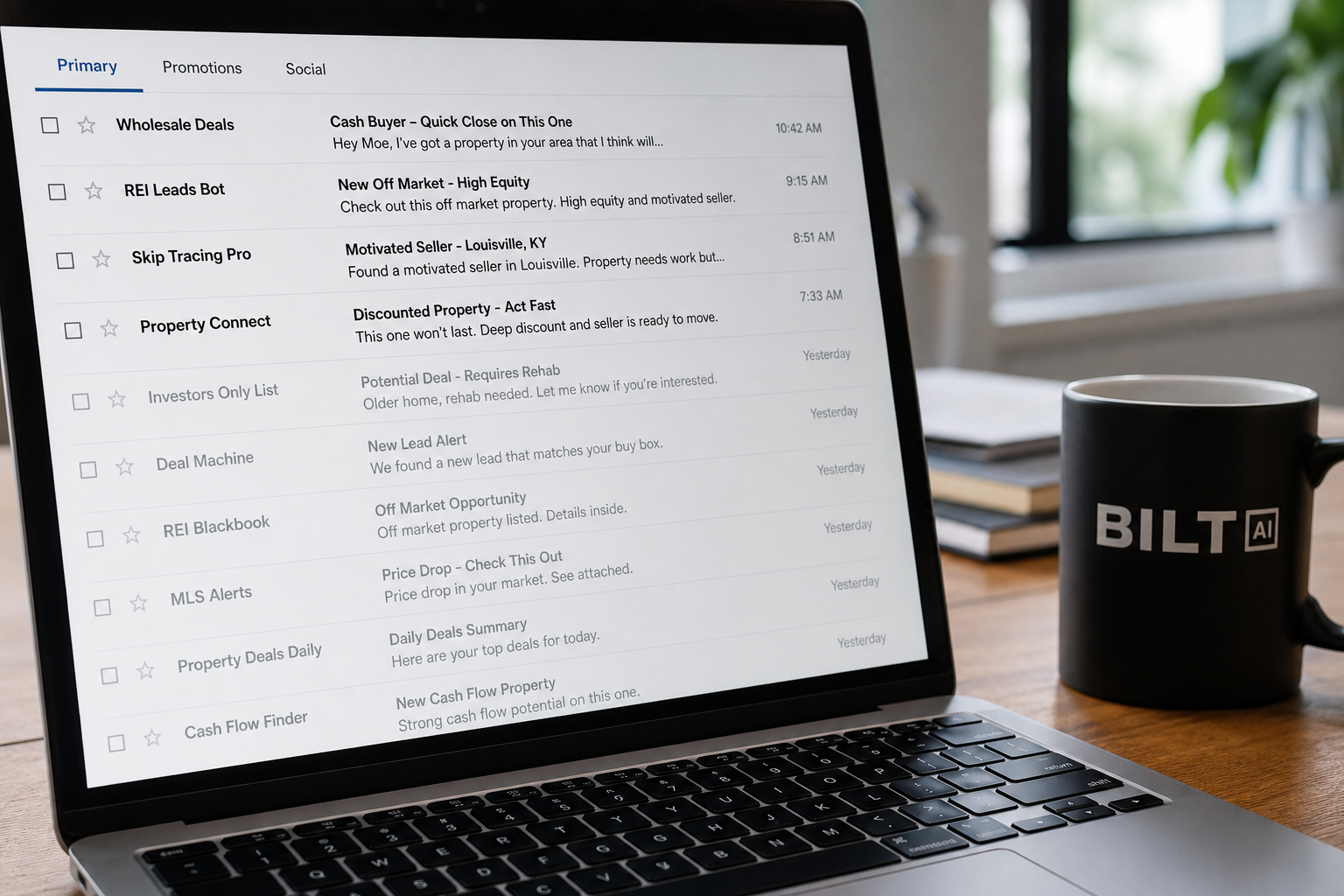
Chris, a Dallas wholesaler, pulled a list of cash buyers from PropStream and blasted the same deal email to all of them. He had activity on paper. Open rates looked fine. Replies were almost nonexistent.
His assumption was that the data was bad. It wasn’t.
The problem showed up in the replies he did get. “Already saw this.” “Not my area.” “Stop sending me stuff outside my criteria.”
That’s not a data issue. That’s a system issue.
Buyer list building for dispositions breaks when the list is treated like a static asset. Names go in. Emails go out. Nothing adapts.
Serious operators don’t run dispositions like that anymore. They run a loop. Every buyer interaction feeds the next touch. Every property signal changes the message.
The shift matters because transaction speed matters. According to the National Association of Realtors, time on market has tightened in many regions, which compresses the window to move deals. A static list cannot keep up with that pace.
Why most buyer lists fail even with good data

Pulling a “cash buyers” list has become easy. Tools like PropStream and county records give you more names than you can realistically work.
That abundance creates a false sense of progress.
Most operators stop at ownership data. They never layer behavior. They never track patterns. They never adjust messaging.
The result is predictable. You get a bloated list that looks impressive and performs like spam.
There’s also a timing problem. Since the 2024 Google and Yahoo sender updates, bulk senders without engagement signals get filtered harder. Google’s official sender guidelines make it clear that engagement and relevance now directly impact deliverability (source).
So even if your list is technically correct, your emails land in the wrong place if buyers don’t engage.
That’s where most dispositions pipelines quietly break. Not at acquisition. Not at pricing. At distribution.
The loop behind buyer list building for dispositions
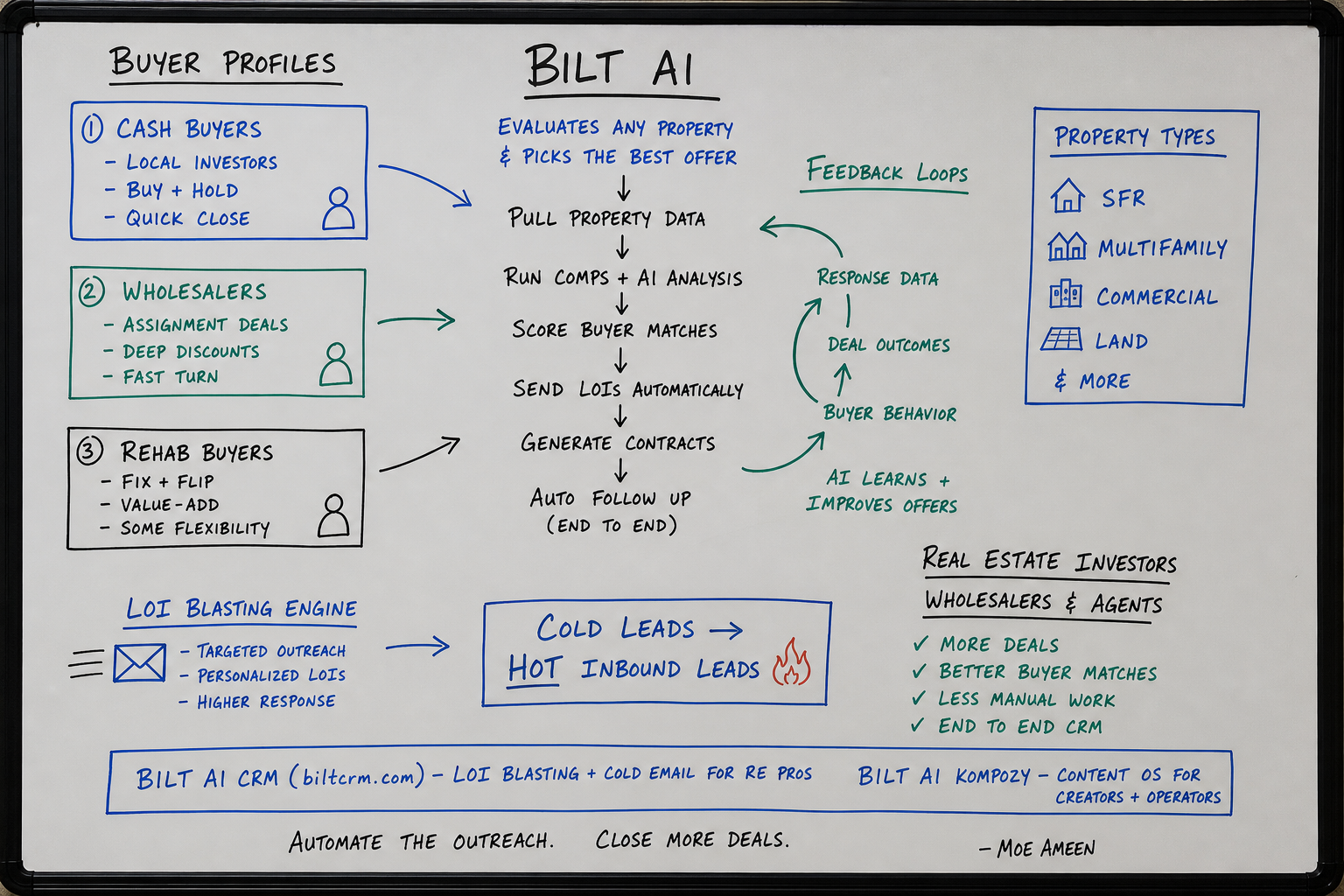
The operators who consistently move deals don’t think in terms of lists. They think in terms of loops.
That loop has three parts, and each one compounds the next.
1. Start narrow, not broad
Instead of “cash buyers in Texas,” the filter gets tight. Single family buyers. Specific zip codes. Repeat purchase behavior. Recent activity.
This reduces volume but increases signal. The first hundred buyers matter more than the next thousand.
2. Layer behavior, not just ownership
Ownership tells you who bought. Behavior tells you who is buying.
Operators track things like repeat LLC names, agent overlap, recent closings, and listing activity. These signals update weekly, not quarterly.
3. Rotate messaging based on activity
Most people rotate messaging based on time. New week, new blast.
That’s backwards.
Messaging should rotate based on what the buyer just did. Bought a rental? Send yield-focused deals. Listed a flip? Send heavier margin opportunities.
This is where systems separate from spreadsheets. Once behavior changes, the message changes with it.
Operator vignette: how a micro-list outperformed a massive list
A dispositions manager in Phoenix rebuilt their buyer list after months of slow deal movement. Instead of adding more contacts, they cut the list down and rebuilt it around recent activity.
The working set was just over a hundred buyers. Each contact had at least two behavioral signals attached, including recent purchases and repeat entity patterns.
Within one quarter, the response pattern changed. Buyers started replying with specifics instead of generic passes. One message stood out: “Send me anything like this before it hits your list.”
The change wasn’t volume. It was relevance.
The old approach pushed deals out. The new system pulled buyers in.
This lines up with broader behavior trends. According to a 2024 report from Pew Research, users are more likely to engage with communication that reflects recent behavior and intent signals rather than generic outreach.
The artifact: micro-list activation system (save this)
This is the exact framework used to turn a cold buyer list into an active dispositions channel. Keep it simple and enforce thresholds.
Micro-List Activation Checklist
- List size cap: Start with 100 to 150 buyers max. If it’s bigger, you’re hiding behind volume.
- Signal requirement: Minimum of 2 behavioral signals per buyer (recent purchase, listing, repeat LLC, agent overlap).
- Data refresh cadence: Update signals weekly using PropStream or county data.
- Message variants: Write 5 deal angles tied to behavior (rental yield, flip margin, off-market access, speed, financing terms).
- Send logic: Only send deals that match at least one known signal.
- Reply tracking: Tag responses by intent (buy now, pass, future interest).
- Prune rule: Remove buyers with zero engagement after multiple relevant sends.
Most people skip at least three of these steps. That’s why their list never wakes up.
Where systems replace manual dispositions work
Once the loop is clear, the next constraint shows up fast. Execution.
Tracking signals manually works at small scale. It breaks once deal flow increases.
This is where most operators either stall or overhire.
The better path is systemizing the loop. That’s exactly what tools like Kompozy were built for. Persona mapping, signal tracking, and content generation all tied to a specific buyer segment.
Each time a buyer signal changes, new messaging gets generated automatically. Not generic templates. Context tied to what that buyer is actually doing.
On the outreach side, BILT AI CRM handles the distribution layer. LOI blasting, follow-up, and inbox management in one place, without breaking deliverability rules tied to modern email requirements.
If you’re still running dispositions from a spreadsheet and a Gmail tab, the ceiling is closer than you think.
The contrarian take: bigger buyer lists hurt dispositions
Most wholesalers believe scaling means adding more buyers.
That instinct slows you down.
Larger lists dilute relevance. They force generic messaging. They reduce engagement signals, which then affects inbox placement under current email standards.
A smaller, behavior-driven list produces faster assignments because every send is intentional.
This shows up in how deals move. Tight lists create inbound replies. Broad lists create noise.
The operators closing consistently aren’t sitting on the largest databases. They’re running the most responsive ones.
What to do in the next 48 hours
1. Build a micro-list. Pull 100 buyers from PropStream or county records. Filter by recent activity, not just ownership.
2. Attach signals. Add at least two behavioral markers to each contact. Use recent purchases, listing activity, or repeat entities.
3. Write targeted messages. Create five deal angles tied to those signals. No generic blasts.
4. Send selectively. Match deals to buyers based on behavior, not geography alone.
5. Track replies. Tag responses and adjust your list weekly based on engagement.
If you want to see how this runs without manual tracking, book a walkthrough here: see how we handle this for wholesalers.
For content and buyer messaging systems tied to signals, explore Kompozy.
Frequently Asked Questions
How do I build a cash buyer list for wholesaling?
Start with recent transaction data, not just ownership records. Tools like PropStream show buyers who actually closed deals, which gives you active demand instead of outdated contacts.
How many buyers should be on my list?
A focused list of around 100 to 150 engaged buyers outperforms larger lists. Operators see stronger reply rates when every contact matches a clear buying pattern.
What makes a buyer list convert better?
Behavior signals drive conversions. Buyers who recently purchased or listed properties are far more likely to respond than static contacts with no recent activity.
Should I send every deal to my entire list?
No. Matching deals to buyer behavior increases engagement. Broad blasts reduce replies and hurt email deliverability under current sender guidelines.
What tools help with buyer list building for dispositions?
PropStream helps source buyers, while systems like BILT AI CRM manage outreach and follow-up. Together they replace manual tracking and improve consistency.