
Cold Email Real Estate Leads That Actually Convert
By 2027, most off-market deals will start with cold email

A wholesaler in Dallas stared at a Gmail tab showing a thread that started with a simple subject line: “Quick question about your property.” Three replies later, the seller asked, “Can you send an offer today?” That deal did not come from driving for dollars or a list pull alone. It started with cold email real estate leads handled correctly.
The shift is already underway. After the 2024 sender requirement updates from Google and Yahoo, inbox placement became a gating factor. Operators who figured out deliverability now control attention. Those still blasting from a single domain keep wondering why responses dried up.
This post breaks down what actually converts in cold email for real estate. Not theory. The mechanics that move a stranger from a list row to a signed contract.
Why most cold email real estate leads fail before the first send
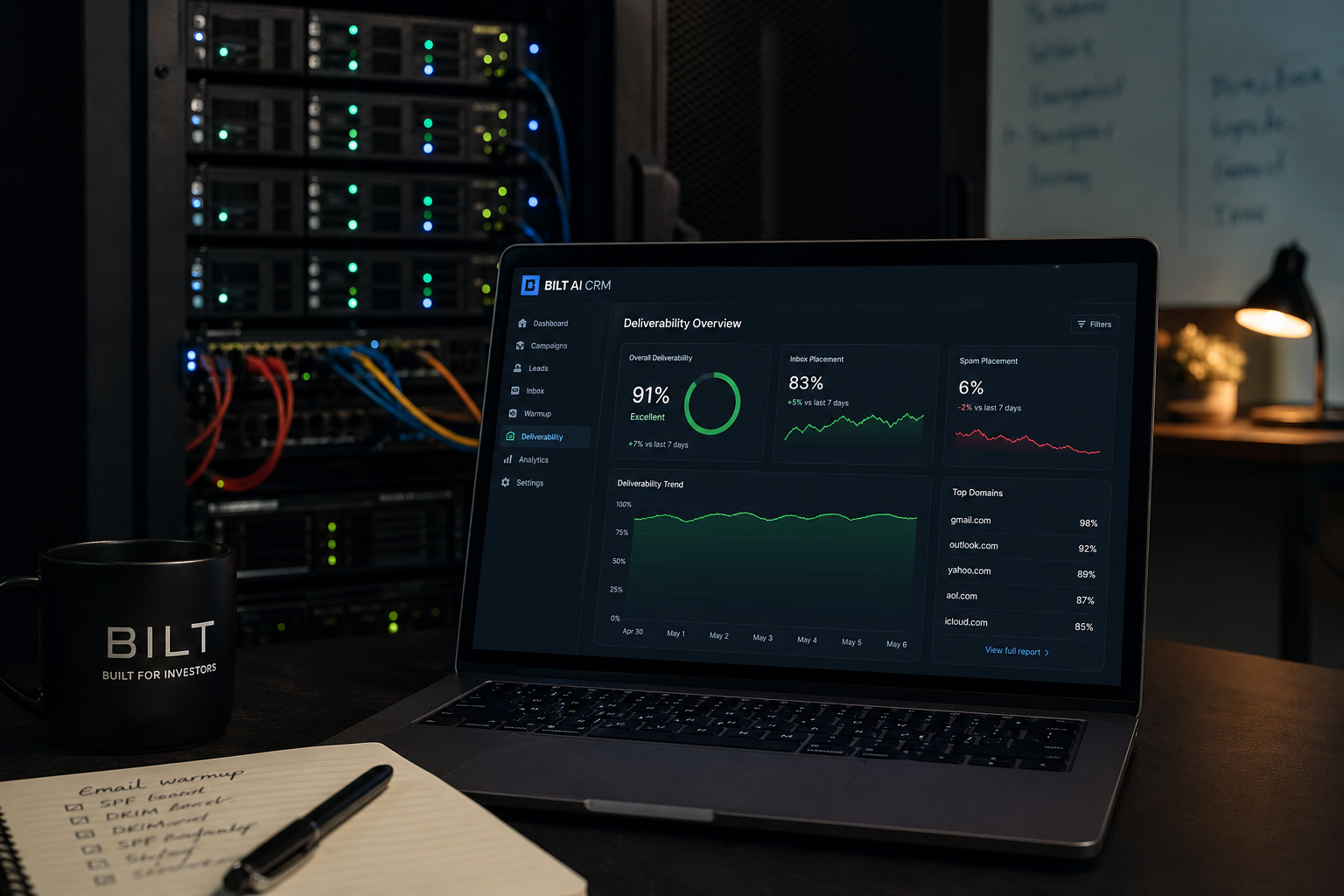
Most campaigns fail before copy even matters. The issue sits at the domain and infrastructure layer. Google’s updated sender rules require authentication and low spam complaint rates. If you ignore that, your emails land in spam or promotions regardless of how good the offer is.
Google documents this directly in its sender guidelines at Google Postmaster Tools. Domain reputation and authentication are non negotiable. The same applies to Yahoo’s requirements published in 2024 at Yahoo Sender Hub.
One operator vignette that illustrates this clearly:
Chris, a wholesaler in Tampa, ran a list of distressed owners through a single domain. Over a short stretch, replies dropped off completely. After moving to multiple warmed domains and reducing daily volume per inbox, reply quality shifted from “stop emailing me” to “what’s your offer?” within the next campaign cycle.
The list did not change. The infrastructure did.
The contrarian take: volume is not your advantage anymore

Most advice in real estate says scale volume. Send more, hit more owners, push harder. That approach worked when inbox filters were weaker. It breaks under current rules.
The operators closing deals from cold email real estate leads today are doing the opposite. They are constraining volume per inbox and increasing domain spread. That keeps reputation intact while still reaching the same total list size.
Tools like Mailgun and inbox rotation setups inside platforms like GoHighLevel make this practical. Instead of one sender pushing everything, multiple mailboxes distribute the load.
That shift changes how you think about campaigns. You stop asking how many emails you can send. You start asking how many inboxes you need to safely reach your list.
This is where most wholesalers get stuck. They try to brute force outbound and end up burning domains faster than they can replace them.
The only artifact you need: the BILT inbox scaling checklist
This is the checklist used internally for campaigns sending cold email real estate leads at scale. Save it.
BILT Inbox Scaling Checklist
- Set up at least 3 domains per campaign (Google Workspace or Outlook)
- Authenticate each domain with SPF, DKIM, and DMARC (check via Google Admin)
- Warm inboxes for a minimum of 14 days using a tool like Instantly or Smartlead
- Limit each inbox to 30–50 emails per day during initial campaigns
- Rotate inboxes automatically using Smartlead or custom SMTP routing
- Monitor domain health weekly in Google Postmaster Tools
- Pause any inbox showing increased spam complaints immediately
None of this is optional anymore. If you skip even one step, the rest of your campaign performance becomes unreliable.
Operators who follow this see consistent inbox placement. That consistency is what turns outreach into actual deal flow.
What actually converts a property owner into a reply
Once your emails land in the inbox, the next problem is getting a response. This is where most real estate operators overcomplicate things.
The highest performing emails are simple. Short. Direct. Written like a human, not a marketer.
A typical structure that works:
- Subject: “Quick question about your property”
- First line: Ask if they would consider an offer
- Second line: Mention you are buying in their area
- Close: Keep it open ended and low pressure
No long pitch. No credentials. No paragraphs about your company.
Another vignette:
Maria, an investor in Phoenix, shifted from long emails to two-line messages. Her reply quality changed from price shoppers to actual sellers asking for timelines and closing details.
That change matters because replies drive deliverability. More positive engagement tells Gmail your emails belong in the inbox.
Where LOI blasting fits into cold email real estate leads
Cold email gets the conversation. LOI blasting closes the gap between interest and contract.
Once a seller engages, speed becomes the advantage. Sending a clean Letter of Intent quickly signals seriousness and filters out non sellers.
This is where systems matter. Manually drafting offers slows you down. Automated workflows tied to your email replies let you move from “yes I am interested” to a structured offer without delay.
If you are running this at any meaningful scale, spreadsheets and manual drafting break fast. That is why we built BILT AI CRM to handle LOI blasting and outbound in one system. It connects your email conversations directly to offer generation so you are not switching between tools.
The operators winning here are not necessarily better negotiators. They are faster to formalize interest into something tangible.
How to turn cold email into inbound deal flow
The end goal is not sending emails. It is creating a system where sellers come back to you.
When your domains stay healthy and your messaging stays consistent, something interesting happens. Replies compound. Conversations reopen. Referrals start appearing from previous threads.
This is the shift from outbound to inbound powered by cold email real estate leads. You are no longer chasing every deal manually. The pipeline starts feeding itself.
It does not happen overnight. It comes from running the same system consistently without burning your infrastructure.
If you want to shortcut the trial and error, the fastest path is seeing how this is set up end to end. You can book a walkthrough and see exactly how we structure inboxes, campaigns, and LOI workflows for operators running real volume.
What to do in the next 48 hours to fix your cold email system
- Audit your domains in Google Postmaster Tools and confirm authentication is passing
- Set up at least two additional sending domains in Google Workspace or Outlook
- Start warming new inboxes using Instantly or Smartlead before your next campaign
- Rewrite your email copy to under five sentences and remove all fluff
- Map your reply flow to a simple LOI process so you can respond quickly to interest
Run this once and you will see where your bottleneck actually is. Most operators find it is not the list.
Frequently Asked Questions
Does cold email work for real estate leads today?
Yes, cold email real estate leads still work when deliverability is handled correctly. Operators using authenticated domains and warmed inboxes continue to generate seller replies through Gmail and Outlook.
How many emails should I send per day for real estate?
Start with 30 to 50 emails per inbox per day. Campaigns that exceed this early often see inbox placement drop, which reduces total replies despite higher volume.
What is the best tool for real estate cold email?
Tools like Smartlead and Instantly are commonly used for inbox rotation and warming. Many operators pair these with CRMs that handle LOI workflows to move faster after replies.
Why are my cold emails going to spam?
Your emails are likely failing authentication or damaging domain reputation. Google’s sender guidelines require SPF, DKIM, and DMARC to be configured correctly for inbox placement.
How do I turn replies into actual deals?
Convert replies into structured offers quickly using LOIs. Operators who respond with clear next steps and timelines see higher conversion from conversation to contract.