
Cold Email for Real Estate Works Without a Routine
The operator in Houston who skipped the routine and closed anyway

A wholesaler in Houston sat staring at a list of off-market owners inside Google Sheets, half-built CRM on one tab, Gmail on another. No morning routine. No journaling. Just a question: who actually needs what he can do?
He started sending emails to owners of small multifamily properties that had clear signs of distress, tax issues, aging assets, inconsistent ownership records. The message was simple. “If you’re tired of managing this, I’ll make you an offer this week.”
No branding. No funnel. No polished system.
Replies came in anyway. Not because the timing was perfect. Not because his habits were dialed. Because the offer matched a real problem.
That’s the part most people avoid. They optimize their calendar before they optimize their offer.
Cold email real estate deals don’t care about your routine. They care about whether your message hits someone who already wants out.
Why most real estate outbound fails before it even sends
The standard advice in real estate lead generation says consistency wins. Send every day. Build discipline. Trust the process.
That sounds good. It just doesn’t match what actually drives replies.
Most outbound fails before the first email lands because the targeting is wrong. Lists get pulled based on broad filters like absentee owner or high equity. That’s not intent. That’s guessing.
Tools like ListSource or PropStream make it easy to export thousands of records. That’s the trap. Volume replaces thinking.
Google’s own sender guidelines tightened after the 2024 Gmail and Yahoo updates, requiring proper authentication and lower spam complaint rates. That means irrelevant emails don’t just get ignored, they actively damage your ability to reach inboxes over time. Google Postmaster Tools shows this clearly once your domain starts degrading.
The issue isn’t effort. It’s mismatch.
If the property owner has no reason to sell, your email is noise. Send enough noise and your domain reputation tanks before you ever get traction.
The contrarian take: boredom is the real moat in cold email real estate

Most operators think scaling cold email means better tools, better copy, or better automation.
That helps. It’s not the edge.
The edge is doing the same thing long after it stops feeling interesting.
Outbound gets predictable fast. Pull list. Clean data. Send emails. Handle replies. Repeat.
The boredom hits before the results compound. That’s where most people switch strategies, chase a new channel, or convince themselves the list was bad.
Operators who win stay in the same lane longer than feels reasonable.
Inside BILT AI CRM, this shows up clearly. Campaigns that run consistently with stable targeting and clean sending infrastructure outperform ones that constantly reset. Not because the software is different, but because the operator stopped restarting the process.
If you’re constantly changing your angle, your list, or your system, you never give the data time to compound.
Cold email real estate is less about creativity and more about staying in the pocket long enough to let replies stack.
The outreach system that actually produces inbound seller conversations
This is where most people expect a list of tips. That’s not what moves the needle.
What matters is having a system you can run without thinking.
The 5-part outbound system operators actually use
- Target distress signals, not demographics
Look for indicators like code violations, tax delinquency, inherited ownership, or aging portfolios. Skip generic filters like “high equity.” - Segment by problem type
A landlord dealing with evictions responds differently than an out-of-state owner with deferred maintenance. Your messaging should reflect that. - Send from warmed infrastructure
Use tools like Mailreach or Warmup Inbox to stabilize deliverability before scaling volume. - Keep the email simple
Short, direct, and specific beats clever. One idea per email. One action. - Reply fast and qualify faster
Speed matters more than scripting. The first meaningful response often sets the deal trajectory.
This system works because it mirrors how deals actually happen. Not through perfect funnels, but through timely conversations with the right owners.
Operators running this at scale usually outgrow spreadsheets quickly. That’s where something like BILT AI CRM becomes necessary, especially when managing segmented outreach and reply handling across multiple campaigns.
What changed after the 2024 email rules and why most wholesalers felt it
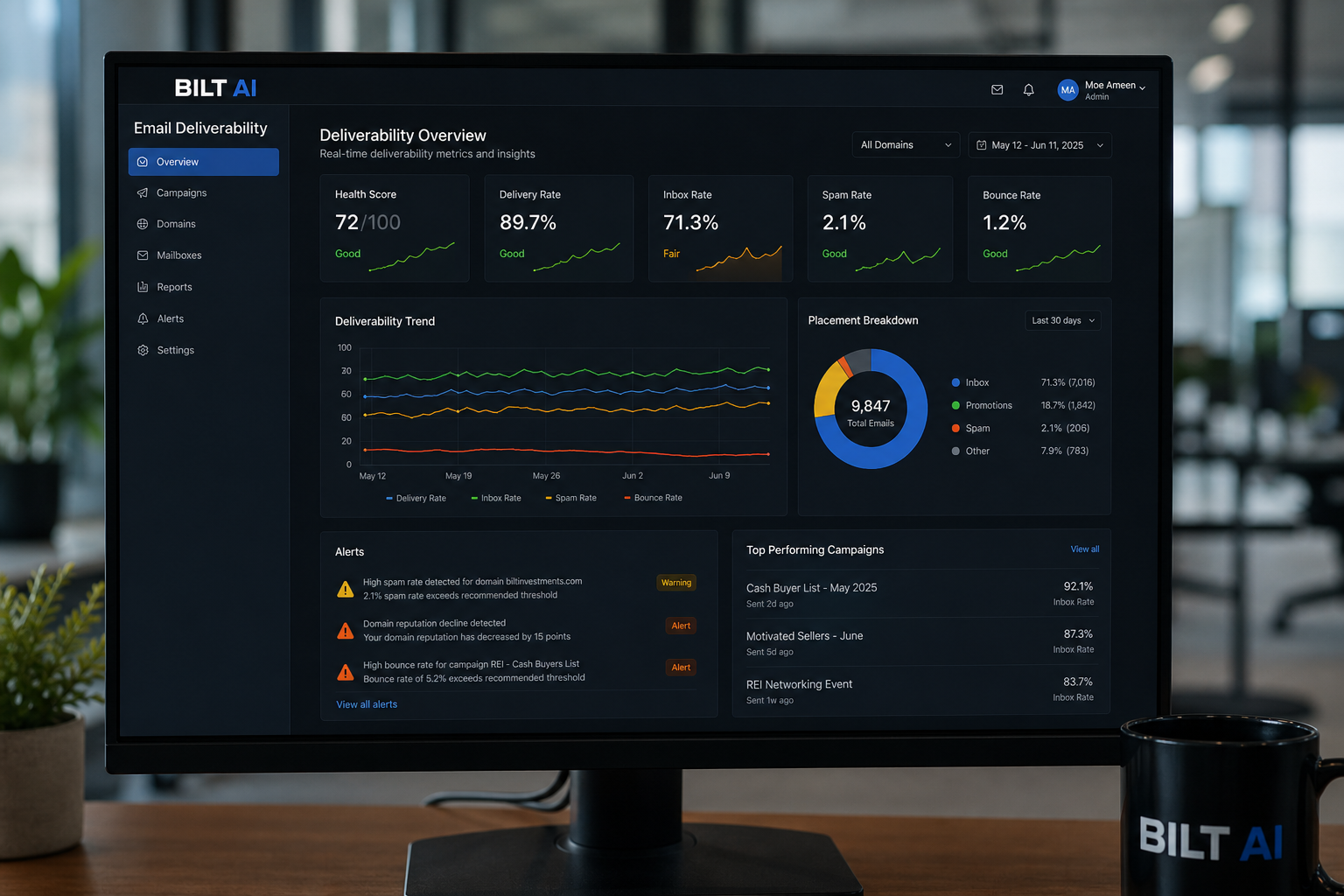
Email got stricter. Quietly, but significantly.
Google and Yahoo introduced new requirements around authentication, spam complaint thresholds, and sender behavior. Bulk senders who ignored this saw inbox placement drop fast.
This hit real estate outbound hard because many operators were already sending high volume with low targeting precision.
According to FTC guidance on email marketing compliance, misleading or irrelevant messaging increases complaint rates, which now directly impacts deliverability algorithms.
The shift forced a change in how cold email real estate campaigns are built:
- Smaller, more targeted sends outperform large blasts
- Domain health matters as much as list quality
- Reply rates matter more than open rates
Operators who adapted leaned into better segmentation and cleaner infrastructure. Operators who didn’t saw campaigns stall and assumed cold email stopped working.
It didn’t stop working. It just stopped forgiving sloppy execution.
Why your offer matters more than your cadence
There’s a quiet assumption in real estate marketing that more touches equal more deals.
That only holds if the underlying offer is strong.
If your email says the same thing as every other investor in the market, increasing volume just increases how often you get ignored.
Strong offers in cold email real estate tend to have three characteristics:
- They acknowledge a specific pain point tied to the property
- They remove friction from the selling process
- They create a reason to respond now, not later
This doesn’t require complex copywriting. It requires clarity.
The Houston operator didn’t win because of perfect timing. He won because the message aligned with owners already considering an exit.
Once that alignment exists, consistency amplifies results. Without it, consistency just compounds inefficiency.
What to do in the next 48 hours if you want replies
Skip the routine overhaul. Focus on execution.
- Pull a distress-based list
Use PropStream or your county records to identify owners with clear friction points tied to the property. - Set up a clean sending domain
Authenticate SPF, DKIM, and DMARC, then warm the inbox using Mailreach before sending anything at scale. - Write one simple email
Keep it direct. One sentence that speaks to the problem, one sentence that asks for a response. - Send a controlled batch
Start small. Watch replies, not opens. Adjust based on actual conversations. - Handle replies immediately
Speed to response beats perfect scripts. Move qualified leads into real conversations quickly.
If the system feels manual, that’s normal. It should. Automation comes after signal, not before it.
If you want to see how this gets structured into something scalable without breaking deliverability, book a walkthrough of BILT AI CRM. It’s built specifically for real estate operators running outbound at volume.
Frequently Asked Questions
Does cold email still work for real estate investors?
Yes, when targeting and deliverability are handled correctly. Campaigns using segmented distress-based lists consistently generate replies, while broad absentee lists often get ignored or filtered.
How many emails should I send per day for real estate deals?
Start with a controlled volume and increase based on domain health. Tools like Google Postmaster show when your reputation supports higher sending without hurting inbox placement.
What kind of properties respond best to cold email?
Properties with clear friction points like tax delinquency, deferred maintenance, or inherited ownership respond more often because the owner already has a reason to consider selling.
Do I need a CRM to run cold email for real estate?
Not at the beginning, but it becomes necessary once you manage multiple campaigns and replies. Platforms like BILT AI CRM are designed to handle segmented outreach and follow-ups at scale.
Why are my cold emails going to spam?
Most often due to poor domain setup or irrelevant targeting. Google’s sender requirements emphasize authentication and low complaint rates, both of which break when messaging is off.