
Fear in Cold Email: What Actually Holds You Back
A Dallas wholesaler paused before hitting send

A Dallas wholesaler sat on a draft with over a hundred property owners queued up, cursor blinking. The list was clean. The copy was simple. The hesitation had nothing to do with data.
The line that stuck was short: "What if this burns my domain?"
That moment shows up more than most operators admit. Fear in cold email rarely looks like panic. It shows up as delay, over-editing, or constantly "improving" a list that was already usable.
The cost is not abstract. Every day an outreach system stays idle, inbound never gets a chance to exist. In a business where deals are tied to timing, hesitation compounds fast.
This is where most content gets it wrong. The advice usually points at confidence or mindset. That is not the bottleneck. The real constraint sits in systems, not emotions.
The contrarian take: fear is not the problem, ambiguity is
The industry frames fear like a personal issue. It is treated like something to overcome with repetition. That framing misses what actually stops operators.
Ambiguity creates hesitation. When an investor does not know what happens after pressing send, the brain fills the gap with worst-case scenarios.
Cold email has real technical consequences. Domain reputation, inbox placement, and spam filtering are governed by systems like Google Postmaster Tools. Since the 2024 sender requirement updates from Google and Yahoo, authentication and sending behavior matter more than ever.
Per Google’s official guidance on bulk sender requirements (2024), senders must maintain low spam complaint rates and proper authentication to reach inboxes. That is not a mindset problem. That is a systems problem.
When those systems are unclear, hesitation is rational. No operator wants to burn a domain tied to active deals or marketing channels.
So the goal shifts. Instead of "removing fear," the objective is to remove unknowns. Once the mechanics are visible, action follows naturally.
What actually happens when you send 500 emails in real estate
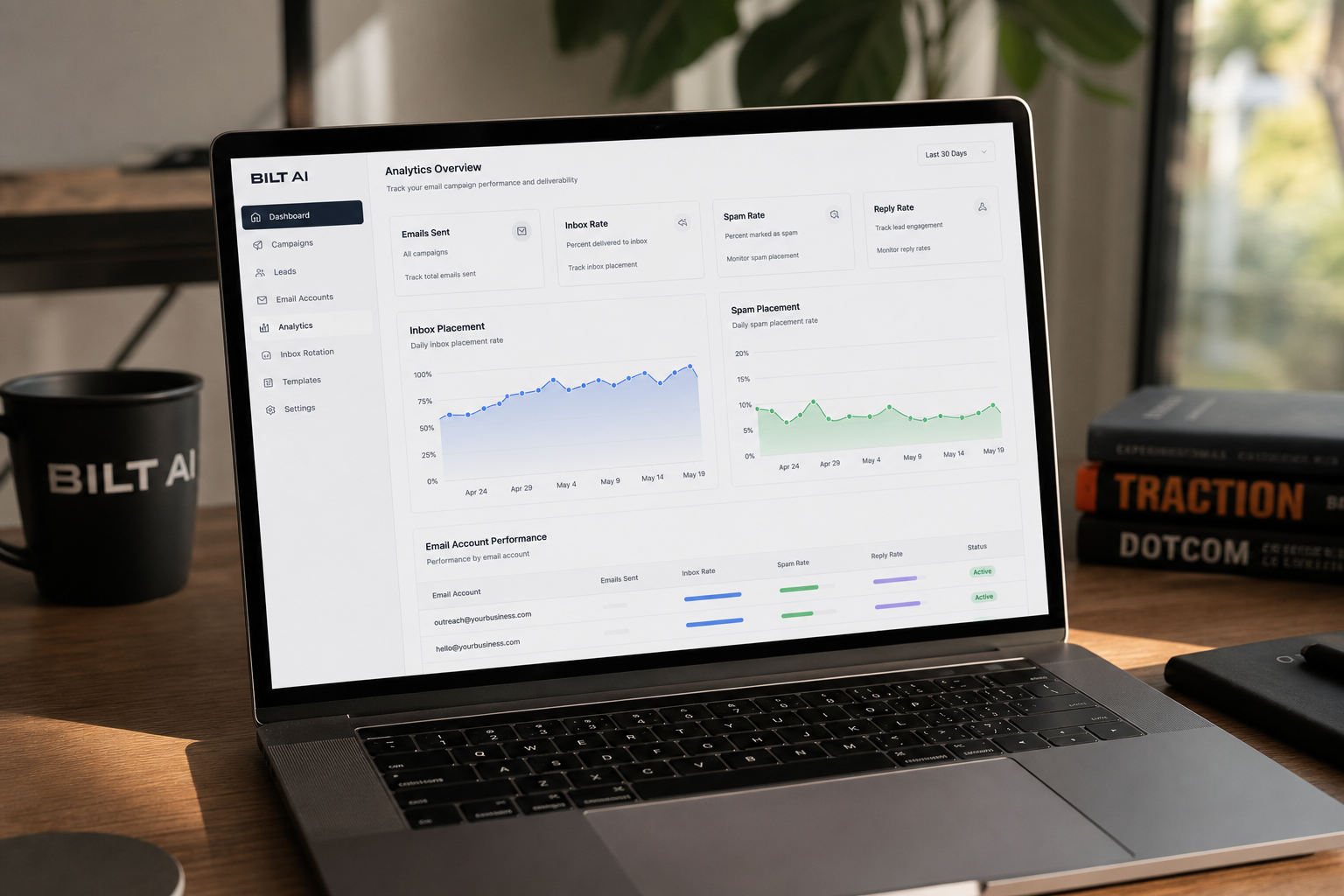
There is a gap between what people think happens and what actually happens when a campaign goes out.
Email providers like Gmail and Outlook evaluate behavior across a few clear signals: authentication, consistency, engagement, and complaint rates. Tools like Mail-Tester or Google Postmaster give visibility into this.
A Phoenix investor running small multifamily outreach learned this the hard way. After weeks of hesitation, he sent a batch without warming the domain. Inbox placement dropped fast, and responses were almost nonexistent.
The issue was not the list. It was sending behavior. Once volume was stabilized and the domain was warmed properly, reply rates recovered without changing the core message.
This is where fear often misfires. The assumption is that one send ruins everything. In reality, most deliverability problems come from patterns, not single actions.
Understanding that difference changes how you operate. It replaces hesitation with controlled execution.
The operator artifact: a real estate cold email send threshold framework
This is the piece most operators end up saving and reusing. It removes guesswork and gives a clear starting point.
Cold Email Send Threshold Framework (Real Estate Operators)
- Domain age before sending: minimum 14 days with inbox activity (Gmail or Outlook)
- Daily send volume per inbox: start under 30 emails, increase gradually each week
- Number of inboxes per domain: 2 to 3 inboxes to distribute volume
- Authentication setup: SPF, DKIM, DMARC verified using Google Admin or similar
- Spam complaint threshold: keep under 0.3% per Google guidance
- Reply signal: aim for consistent replies, even neutral responses help reputation
- List segmentation: separate absentee owners, multifamily, and on-market sellers
Each of these ties directly to how providers evaluate your behavior. None of them require guessing.
Operators who follow this framework stop second-guessing every send. The process becomes repeatable, which is what turns outbound into inbound over time.
A Miami agent replaced hesitation with a system

Adrian, an agent in Miami focused on small multifamily, had a pattern of starting campaigns and stopping within days. The reason sounded familiar: concern about deliverability.
He shifted to a structured approach. Domains were warmed. Volume increased gradually. Lists were segmented between distressed owners and long-term holders.
The difference showed up in behavior first. Campaigns ran consistently instead of in bursts.
Within a few weeks, replies started to stack. Not every response turned into a deal, but conversations increased. One message summed it up: "Timing is interesting, I’ve been thinking about selling."
The change was not creative copy or a new niche. It was removing ambiguity from the system.
That is what most operators are actually missing when they say they are "stuck."
Why most cold email advice fails real estate operators
Generic advice treats cold email like e-commerce or SaaS outreach. Real estate operates differently.
You are not chasing clicks. You are starting conversations tied to assets, timing, and personal decisions.
The Federal Trade Commission outlines commercial email compliance clearly under CAN-SPAM rules, including identification and opt-out requirements (FTC CAN-SPAM Guide). Real estate outreach sits inside that framework, but the execution is more nuanced.
A wholesaler reaching out about an off-market duplex is not sending a newsletter. The message has to feel direct and relevant without triggering spam filters.
This is where fear creeps back in. Operators try to sound "safe" and end up sounding generic. That hurts response rates more than any technical issue.
Clarity in both compliance and messaging removes that friction. Once those are handled, sending becomes operational, not emotional.
Where BILT AI CRM fits when volume increases
Once outbound moves past a few inboxes and a handful of lists, manual tracking breaks down. Follow-ups get missed. Conversations fragment across inboxes.
This is the point where systems matter more than effort. Operators running consistent outreach typically move into structured platforms.
If you are managing multiple lists and ongoing campaigns, that is where BILT AI CRM comes into play. It was built specifically for real estate workflows like LOI blasting and cold email, not generic pipelines.
The benefit is not just sending emails. It is maintaining continuity from first touch to signed agreement. That is where most deals are lost when systems are loose.
At scale, fear disappears almost entirely. The process is visible, trackable, and repeatable.
What to do in the next 48 hours if fear is slowing you down
- Set up one sending domain using Google Workspace, verify SPF, DKIM, and DMARC, and connect it to Google Postmaster Tools.
- Warm the inbox manually by sending and replying to real emails daily for a short period before any campaign.
- Build a segmented list inside your CRM separating property types and owner profiles instead of blasting one mixed list.
- Launch a small campaign under the daily threshold and monitor replies and placement rather than trying to optimize everything upfront.
- Track responses centrally using a system that keeps conversations tied to properties and contacts.
If you want to see how this is set up specifically for wholesalers and agents, book a walkthrough here: https://www.biltcrm.com/book-demo
For operators building content and outbound systems together, Kompozy is where the backend gets organized: https://kompozy.io
Frequently Asked Questions
Why does fear stop me from sending cold emails?
Fear usually comes from not knowing what happens after sending. Platforms like Google Postmaster Tools show how inbox placement and spam rates work, which turns uncertainty into something measurable.
How many cold emails can I send per day in real estate?
Start with a low daily volume per inbox and increase gradually. Google’s 2024 bulk sender guidelines emphasize consistent behavior and low complaint rates over sudden spikes in activity.
Is cold email legal for real estate deals?
Yes, if it follows CAN-SPAM requirements. The FTC states that commercial emails must include identification and an opt-out option, even when reaching property owners.
What tool should I use to track deliverability?
Google Postmaster Tools is one of the most direct ways to monitor domain reputation and spam rates. It connects directly to Gmail data, which dominates email usage.
When should I use a CRM for cold email outreach?
Use a CRM once conversations start spreading across inboxes or follow-ups become inconsistent. Real estate pipelines involve multiple touchpoints tied to specific properties, which requires structured tracking.