SMS Outreach Compliance for Real Estate Investors
“Just blast more texts. Volume wins.” It doesn’t, and carriers prove it fast

That advice still floats around investor circles, and it’s the fastest way to get filtered. High-volume SMS without compliance signals looks identical to spam at the carrier level.
AT&T, T-Mobile, and Verizon all run filtering layers that prioritize consent, reply behavior, and complaint signals. The moment those signals trend negative, your messages stop landing.
Per the FCC telemarketing guidance, prior express consent is not optional for marketing texts. Carriers enforce that standard algorithmically, not philosophically.
The operators who treat compliance like a growth system, not a legal checkbox, consistently see stronger inbox placement and higher reply density. The rest end up blaming their lists.
What actually improved when compliance was added to live campaigns
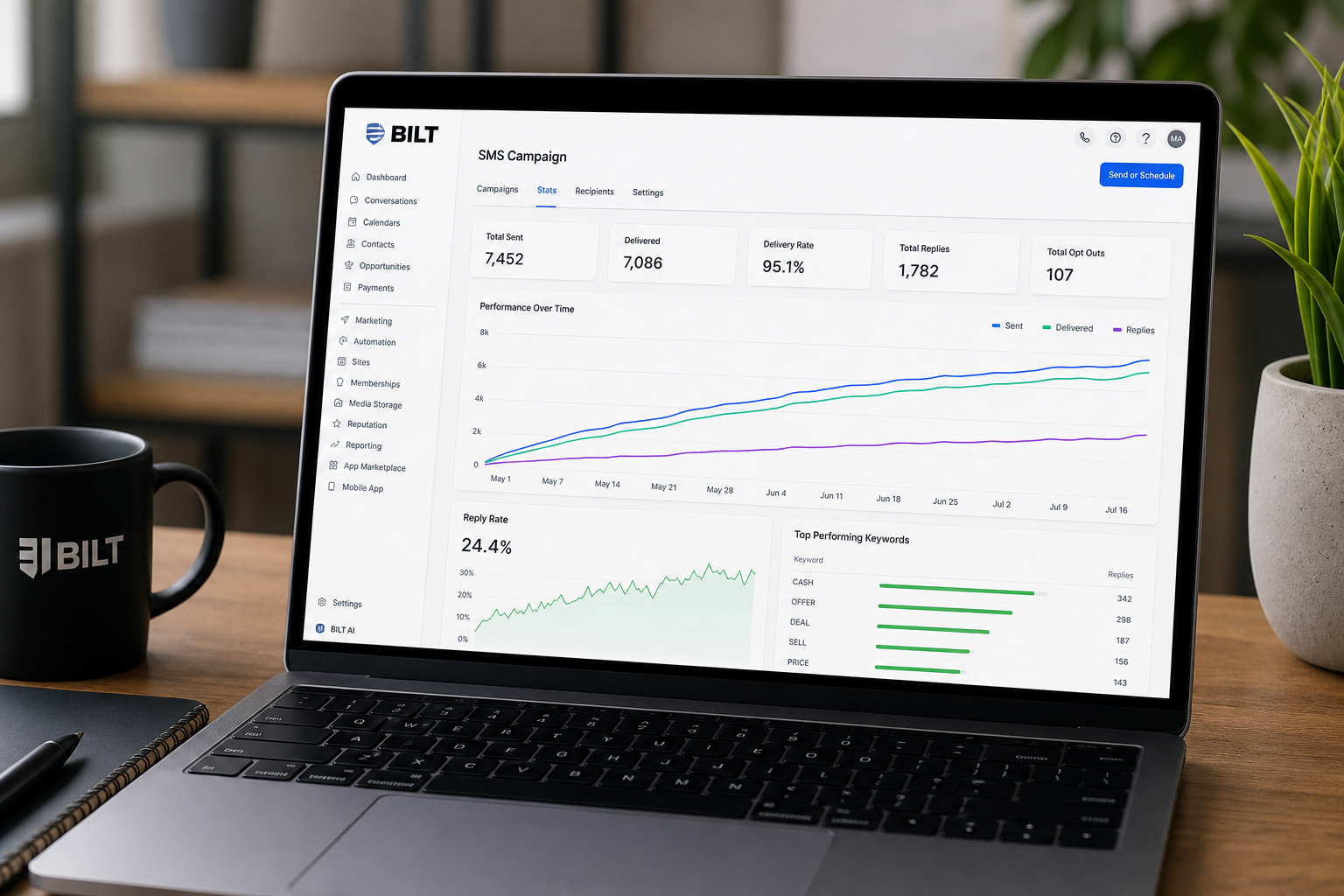
Campaign data showed a clear pattern. When consent tracking was missing, reply rates dropped under 2% and filtering increased. Messages were technically sent, but not seen.
Once three changes were implemented, performance shifted:
- Double opt-in logging tied to each contact record
- Time-of-day controls between 8am and 8pm local
- Automatic STOP handling with suppression lists
Replies increased and conversations followed. Not because messaging copy improved, but because deliverability stabilized.
This lines up with FTC enforcement patterns, where complaint-driven filtering plays a major role in platform restrictions.
The list didn’t grow. It got cleaner. That’s where the lift came from.
Why SMS outreach compliance is a deliverability system, not a restriction

Most investors think compliance slows them down. In practice, it sharpens signal.
Consent-based lists behave differently. Contacts recognize the sender, engage faster, and generate positive carrier feedback loops. That feedback determines whether your next batch lands or gets throttled.
Google’s messaging ecosystem and carrier partners tightened enforcement after recent spam policy updates. While email got the headlines, SMS filtering followed the same direction. Sender reputation now compounds over time.
This is where most outbound operators miscalculate. They optimize for send volume instead of conversation density.
Higher compliance leads to:
- More consistent inbox placement
- Higher reply rates per send
- Lower complaint ratios
That combination increases actual deal flow, not just activity metrics.
The compliant SMS rotation system operators actually use
There’s a simple framework that consistently performs in real estate outreach. It balances compliance, variation, and carrier trust.
Save this and implement it directly
- Create 3 message variants per campaign, each with clear opt-out language ("Reply STOP to opt out")
- Segment your list by intent (seller leads, follow-ups, stale prospects)
- Rotate message variants across segments to avoid repetition patterns
- Cap sending velocity at 200 messages per hour per carrier route
- Restrict delivery windows to 8am–8pm in the recipient’s timezone
- Log and store opt-in proof for every contact
This structure prevents pattern detection while reinforcing compliance signals. It also reduces message fatigue across your list.
Tools like Twilio Messaging or compliant CRMs make enforcement easier, but the system matters more than the tool.
In Kompozy, this gets automated. Persona Brief defines message framing, Brand Prompt Lane enforces opt-out language, and the system rotates approved variations without triggering spam filters.
If you’re manually cycling through spreadsheets and copy-pasting texts, this is where things break at scale.
Operator vignette: what changed after fixing compliance signals
A wholesaler running outbound SMS campaigns rebuilt their pipeline after consistent filtering issues. Before changes, reply rates were under 2% and inbound conversations were inconsistent.
After implementing structured opt-ins, compliant messaging, and controlled send windows, replies doubled within a few weeks.
"Nothing about the list changed. Once messages started landing properly, people actually responded."
The difference wasn’t creativity or volume. It was deliverability.
This pattern shows up repeatedly across investor campaigns. When compliance improves, performance follows without increasing spend or list size.
Where most investors get SMS compliance wrong
The common mistakes are predictable, and they all point back to misunderstanding how carriers evaluate traffic.
- Sending too fast, which triggers velocity-based filtering
- Skipping opt-in documentation, leaving no compliance proof
- Reusing identical scripts across large lists
- Ignoring opt-outs or delaying suppression updates
Each one chips away at sender reputation. Combined, they collapse deliverability.
The CTIA messaging guidelines outline how carriers expect messaging programs to operate. Enforcement isn’t theoretical. It shows up as reduced reach.
Investors often assume poor results mean bad data. In many cases, the issue is that the message never had a fair shot at being seen.
How this ties directly into inbound deal flow
Outbound SMS is supposed to create conversations. When compliance is dialed in, those conversations compound into inbound opportunities.
That’s where most operators hit a ceiling. They fix deliverability, responses increase, and suddenly they’re juggling threads across multiple platforms.
If you’re running this at scale, you’ll outgrow manual follow-up quickly. That’s exactly why BILT AI CRM was built. It evaluates property data, sends compliant outreach, and follows up automatically so inbound interest doesn’t stall.
The connection is straightforward. Better compliance leads to better delivery. Better delivery leads to more replies. More replies create inbound deal flow. The system handling those conversations determines whether they close.
What to implement before your next SMS campaign goes out
Clean execution here changes results quickly. This is the short window to fix before sending your next batch.
- Audit your current list. Remove contacts without clear opt-in records.
- Write three compliant SMS variants with opt-out language included in each.
- Set sending limits inside your platform or API to control hourly volume.
- Enable automatic STOP handling and confirm suppression lists update instantly.
- Test delivery across small batches before scaling sends.
Most investors don’t need more leads. They need their current outreach to actually land and convert.
If you want to systemize how content, messaging, and outbound workflows connect, Kompozy handles that layer. You can see how it structures compliant messaging at Kompozy.
Frequently Asked Questions
What is SMS outreach compliance in real estate?
SMS outreach compliance means obtaining and documenting consent before sending marketing texts, including opt-out instructions in every message. The FCC requires prior express consent, and campaigns without it often see filtering and reduced delivery.
Why do my real estate text campaigns have low reply rates?
Low reply rates are usually a deliverability issue, not a copy problem. Campaigns without opt-in tracking or proper send controls have been observed dropping under 2% replies because messages never reach the inbox.
Do I need opt-in for SMS marketing as an investor?
Yes, opt-in is required for marketing texts. FCC and CTIA guidelines both state that prior express consent must be obtained and documented before sending promotional SMS messages.
What is a safe SMS sending volume for wholesalers?
A controlled rate like 200 messages per hour per carrier route helps avoid triggering filtering systems. Sudden spikes in volume often flag campaigns as spam regardless of message quality.
How should I include opt-out language in SMS messages?
Every message should clearly state how to opt out, typically with a line like "Reply STOP to opt out." Campaigns that consistently include this see better carrier trust and fewer complaints.